
Liquidation map
from real positions.
Where leveraged positions get liquidated, built from the real open positions of the largest Hyperliquid accounts, not from an indicator's guess. Use it as a risk tool: the desk's own backtests found no entry edge in it.
01How the map is built
Hyperliquid is transparent: every account's positions carry their exact liquidation price, size and leverage. OUTRIDER:
- Picks accountsThe largest accounts by account value from Hyperliquid's public leaderboard (above USD 25,000,
liqmap.minAccountUsd), 2,000 by default. - Reads their positionsEvery account's open positions, paced to stay under Hyperliquid's rate limit. 2,000–3,000 accounts take about 4–6 minutes.
- Bins the liquidation pricesPer coin, in 0.5 % price bins within ±25 % of the mark. Longs liquidate below the price, shorts above.
Two layers are kept apart:
| Layer | Source | How to read it |
|---|---|---|
| Real | Hyperliquid positions of the accounts read | Actual liquidation prices of those accounts at the time of the scan. It does not include accounts that were not read, or other venues. |
| Modelled (faint) | 30 days of hourly candles × typical 5–100× leverage, erased where the price already ran through | An estimate for venues nobody can see (centralised exchanges). It is what "liquidation levels" indicators draw. Treat it as a guess. |
02Reading the map
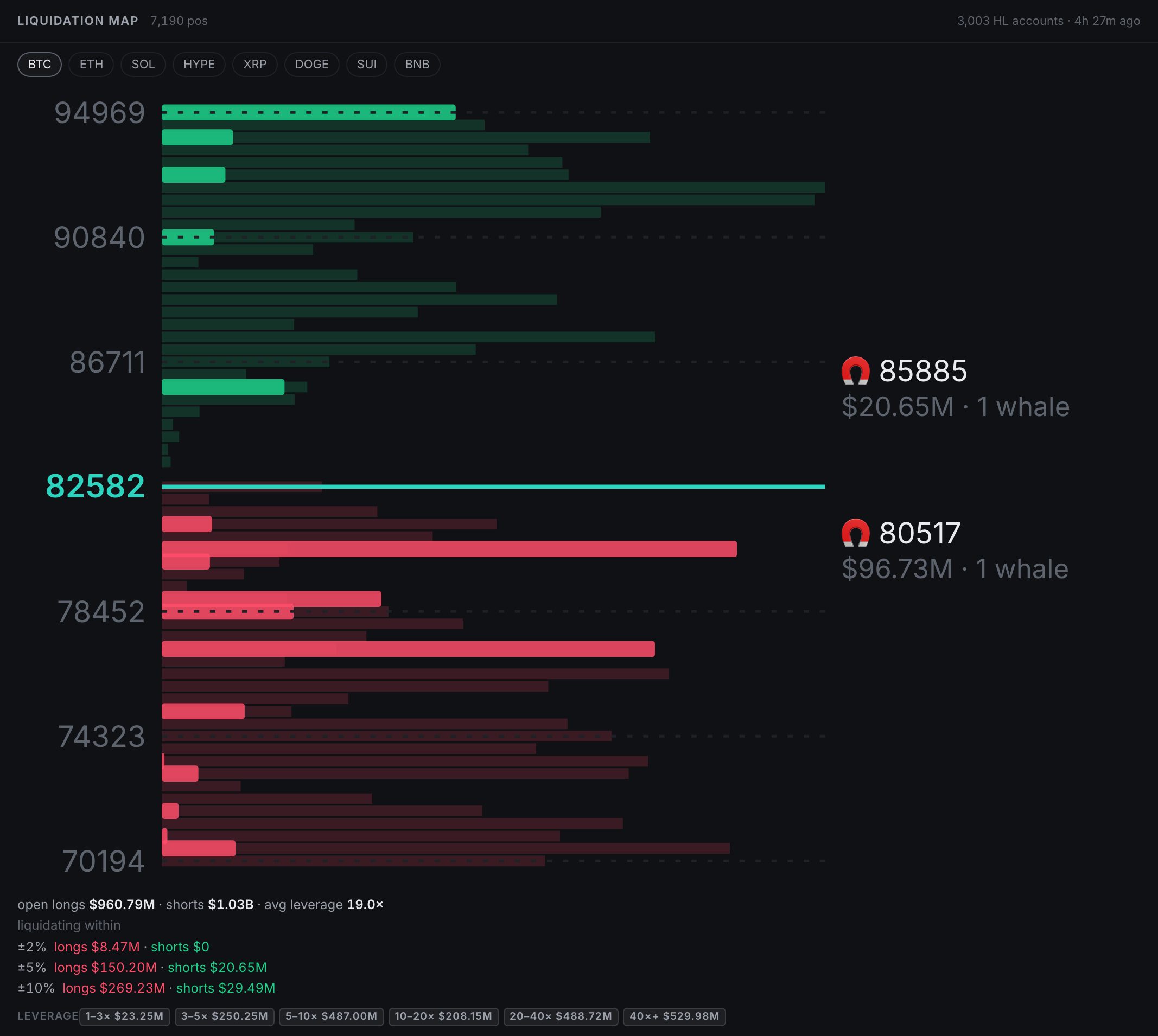
- Bars above the mark line are shorts that liquidate if the price rises there; bars below are longs that liquidate if it falls there.
- Magnet (🧲): the nearest bin on each side that holds at least 8 % of that side's liquidations in range (
liqmap.magnetMinShare). The label says whether it is one whale or a crowd of positions. - Liquidating within ±2/5/10 %: how much long and short notional sits that close to the price.
- Leverage mix: notional by leverage bucket, from 1–3× up to 40×+.
- The terminal version (
liq) also lists the positions closest to liquidation.
03Build it on demand
node src/cli.mjs liq                          # BTC ETH SOL HYPE XRP DOGE SUI BNB, 2,000 accounts
node src/cli.mjs liq BTC,HYPE --wallets 3000  # chosen coins, more accounts (max 20,000)
It prints an ASCII map per coin with both layers and saves data/liqmap.json and appends history lines to data/liqmap-history.jsonl. Addresses in data/x-hl-whales.txt (one or more 0x… addresses, any format) are read as well.
04In the running desk
- The desk rebuilds the real map in the background every 30 minutes (
liqmap.everyMinutes), never inside the 20-second cycle. The live refresh builds the real layer only; runliqfor the modelled layer. - Every cycle it compares the live price with the saved clusters and alerts on Telegram:
- 🧲 approach: the price is within 1.5 % (
liqmap.alertWithinPct) of a cluster holding at least USD 5M (liqmap.alertMinUsd); - 💥 taken: the price ran through such a cluster since the last cycle.
liq_alertrows. - 🧲 approach: the price is within 1.5 % (
- Telegram
/liqor/liq BTCanswers from the latest map. - All of these are set in the console under Liquidation map (mapping).
05What it is good for
Use the map to see where forced selling or buying would start, to size and place your own stops away from crowded levels, and to understand sudden moves. Do not use it as an entry signal: the desk's backtest of the two popular ideas, trading toward a nearby cluster ("magnet") and fading the move after a cluster is taken ("cascade"), judged with costs, walk-forward and against random timing, found no entry edge (src/lab/liqbt.mjs; the console describes the map with "backtests found no entry edge in it"). That backtest runs on the modelled layer, because no venue publishes historical positions.