
Trend, leverage & books
everything beside memecoins.
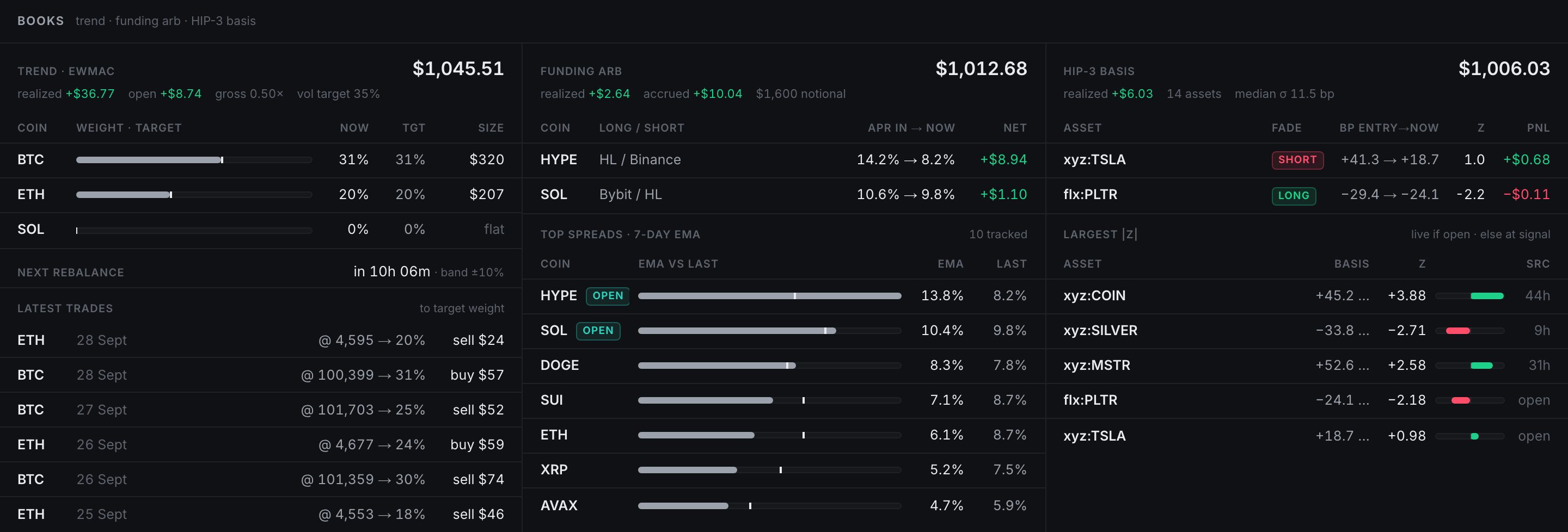
Besides the memecoin desk, OUTRIDER runs several paper books on Hyperliquid and Polymarket, each with its own paper equity, and a capital allocator that sizes them by the evidence in their own journal.
01The books
Every book below trades on paper with live data, starts with its own paper equity (USD 1,000 by default) and can be turned off with <book>.enabled: false in config.json. The kill switch, the daily loss limit and the hard stop block new entries in the perp books (trend, HL copy, carry, XARB, basis) and in both Polymarket books; exits keep running. Gross notional across the perp books is capped at USD 8,000 (portfolio.maxGrossUsd).
| Book | Config key | What it does |
|---|---|---|
| TREND | trend | Volatility-targeted trend following on BTC, ETH and SOL (below). |
| MACRO | macro | Trades news on majors. It enters only when the price reaction since the event agrees with the news at z ≥ 1.5 on above-normal volume, skips when |z| > 4 (already priced in) or when order flow runs against the news. |
| HL COPY | hlcopy | Scores Hyperliquid leaderboard wallets and keeps only those whose edge survives a 2-minute copy delay after fees. Mirrors their positions under a cap on total leverage across all coins. Run node src/cli.mjs leaders once a day; copying stops if leaders were not rescored for 48 hours. |
| CARRY | funding | Delta-neutral funding carry: short the perp and hold spot while funding pays shorts, only when funding over 336 hours pays more than twice the costs. |
| XARB | xarb | Cross-venue funding arbitrage between Hyperliquid, Binance and Bybit: long where funding is cheap, short where it is rich, above 8 % APR after fees. |
| BASIS | basis | Mean reversion of the gap between a HIP-3 stock or commodity perp and its oracle, hedged at the oracle; skips entries while the underlying market is closed. |
| POLYMARKET | polymarket | The 5- and 15-minute BTC/ETH/SOL/XRP Up/Down markets. Fair value from strike, spot, volatility and time left with fat tails; ¼-Kelly after fees; settles from Gamma and cross-checks with Hyperliquid. |
| POLYMM | polymm | Paper market making for Polymarket liquidity rewards, with a conservative fill model (a touch is never a fill; queue position counts). |
| JEV | jev | TypeSafe's Jev forecaster, measured against momentum and base-rate control arms (below). Needs TYPESAFE_API_KEY. |
Prediction markets are restricted or treated as gambling in some countries, and Polymarket's APIs may not answer from every location (doctor shows it). Turn polymarket and polymm off if they do not apply to you.
02TREND
- Signal. By default an ensemble of the sign of returns over 7, 14, 28, 56 and 112 days (
trend.signal: "sign"). Carver's EWMAC is selectable with"ewmac". - Sizing. Targets a portfolio volatility set by the leverage profile, holds a ±10 % no-trade band, rebalances daily, long only by default.
- Costs. 4.5 bps fee and 3 bps slippage per trade; the backtest also charges perp funding.
node src/cli.mjs trend-backtest 1000 # TREND vs BTC buy-and-hold over 1,000 days of Hyperliquid historyThe backtest prints Sharpe, Sortino, Calmar, maximum drawdown and the probability that the Sharpe is above zero, for TREND and for holding BTC. Trend following tends to protect in falling years and lag in rising years: expect it to trail buy-and-hold in a strong bull market.
03Leverage profiles
Leverage is paper-only and applies to the TREND book. Choose the profile in the console (Trend & leverage) or with leverage.defaultProfile.
| Profile | TREND target vol | Max gross | Carry multiplier | Drawdown budget |
|---|---|---|---|---|
safe | 25 % | 1.5× | 1× | 25 % |
growth (default) | 35 % | 2.5× | 1.25× | 45 % |
aggressive | 50 % | 4× | 1.5× | 70 % |
node src/cli.mjs leverage                            # current profile, margin and paper liquidation lines of the TREND book
node src/cli.mjs leverage-backtest 2500 BTC,ETH,SOL  # every profile over real daily OHLC, with liquidations
leverage-backtest checks liquidation against each day's high and low (a close-only test is not enough for leverage), adds a block-bootstrap risk estimate, and names the best profile that stayed inside its drawdown budget without being liquidated. The author's run on 2026-09-27 showed maximum drawdowns of 23.9 % (safe), 31.9 % (growth) and 43.5 % (aggressive). Higher leverage means deeper drawdowns; past samples say nothing certain about the future.
04Funding backtest
node src/cli.mjs funding-backtest 365 BTC,ETH,SOLReplays the CARRY and XARB rules over real Hyperliquid (and Binance) funding history per coin. Hedged legs are assumed and there are no borrow, basis or auto-deleveraging costs, so treat the result as an upper bound.
05Jev, measured
With TYPESAFE_API_KEY set, every hour the desk asks Jev whether BTC, ETH and SOL will be higher in 60 minutes, scores the answers against momentum and base-rate control arms (Brier score, AUC with a confidence interval, reliability) and paper-trades when Jev is confident. By default it only shadows (jev.mode: "shadow"); in "gate" mode it may veto a pump.fun entry, never force one. Spending is capped at USD 2 a day (jev.maxUsdDay).
node src/cli.mjs jev-reportThe report applies a rule fixed in advance: at least 500 decisions, positive skill against both controls, an AUC confidence interval above 0.5 and positive paper PnL. Until then it says "keep shadow mode".
06The capital allocator
Money follows proven paper PnL. Every strategy starts on probation at half size. After 14 days, the probability that its true Sharpe is above zero and its drawdown decide: proven (above 90 %, size ×1.25), active, or paused (below 20 % or too deep a drawdown, token size so it can earn its way back). The status and size multiplier are shown in the dashboard's Strategies table, and changes are sent to Telegram.